AI can write the copy. That was never the hardest part.
Ask an AI tool to analyse a market and, within seconds, you may have a neat summary sitting on your screen.
Useful? Absolutely.
Finished? Not even close.
Someone still has to check the numbers, trace the original sources, open competitors’ websites, compare prices, read customer complaints, separate meaningful signals from assumptions and decide what deserves a test.
Then comes the familiar routine.
Open the analytics platform.
Jump into the CRM.
Find the spreadsheet.
Brief the creative tool.
Update the landing page.
So much for effortless automation.
This gap between getting an AI answer and getting useful work done is precisely why AI marketing agents have become such an important topic in 2026.
For years, generative AI behaved a little like a very articulate satnav.
You told it where you wanted to go.
It suggested a route.
You still drove the car.
An AI agent goes further.
Give it a destination and, within the limits you define, it can inspect the road, consult available information, choose tools, compare possible routes and prepare — sometimes even execute — the next move.
The real shift is not simply towards smarter models.
It is the move from prompt to workflow.
The word agent is everywhere now.
That does not mean every AI feature deserves the label.
A conventional AI assistant usually works like this:
You ask → It answers
An AI agent can work more like this:
Objective → Research → Data → Reasoning → Tools → Verification → Action
There is still an AI model underneath.
What matters is everything surrounding it:
data, permissions, tools, rules, memory, feedback and decision logic.
That surrounding machinery is what turns a clever response into something closer to a working process.
OpenAI reported that, by May 2026, 70.2% of sampled individual Codex users had made at least one request estimated to involve more than one hour of equivalent human work.
More than a quarter had made at least one request estimated at over eight hours.
That tells us something.
People are beginning to ask AI for more than fragments.
Not simply:
“Give me ten Facebook ad headlines.”
But:
“Analyse this market, identify what customers care about, compare the main competitors and tell me which angles deserve testing.”
One objective.
Several stages.
That looks much more like delegated work.
For years, AI optimisation focused on three things:
better prompts, better models, better templates.
AI agents move the question somewhere more operational:
How should the work itself be designed?
What should the agent know?
Where should it look?
Which evidence should it trust?
When should it stop and ask a human?
Those questions matter more than endlessly polishing prompts.
Practical takeaway: pick one recurring marketing task that currently forces you to move between at least three tools. Map the process before trying to automate it.
There is something slightly absurd about modern marketing.
We can now produce twenty campaign concepts before breakfast.
Yet all twenty can still be wrong for exactly the same reason.
Imagine telling an AI:
“Build a campaign for this outdoor light. Focus on security.”
It can write the ads.
Produce the landing-page copy.
Generate the creative concepts.
It might even make the campaign look remarkably polished.
There is only one problem.
What if customers care less about security than they do about avoiding electrical wiring?
Nothing is technically wrong with the output.
The assumption underneath it is wrong.
That is a much harder problem.
Generative AI dramatically lowers the cost of execution.
It does not automatically lower the cost of bad judgement.
Sometimes it does the opposite.
A weak idea suddenly arrives wearing very expensive-looking clothes.
BCG’s 2026 research amongst 300 global CMOs illustrates the gap.
96% said AI was driving end-to-end transformation in marketing.
Yet:
Mark Abraham, Managing Director and Senior Partner at BCG, described the challenge clearly:
“Most marketing organisations are not yet built to compete in that environment.”
The software is moving quickly.
The operating model is moving more slowly.
And simply adding more AI tools does not solve that.
One tool researches.
Another writes.
A third creates images.
A fourth builds pages.
A fifth reports performance.
Fine.
Except the customer still experiences one journey.
If an objection discovered during research never reaches the offer, something has broken.
If the advert promises simplicity but the landing page opens with technical jargon, something has broken.
If campaign performance disappears into a dashboard and never changes the original market hypothesis, something has definitely broken.
You do not have a learning system.
You have a collection of tools.
AI models are becoming common.
Context is not.
The valuable capability may be preserving enough context for one discovery to influence the next decision — then allowing the result of that decision to improve whatever happens afterwards.
That is the loop worth building.
Not an endless library of clever prompts.
Practical takeaway: when evaluating an AI platform, ask three questions:
What information goes in?
What decision comes out?
What does the system learn from the result?
Picture a familiar e-commerce situation.
Someone finds a product that looks promising.
Excitement kicks in.
The team starts discussing creatives, TikTok ads, pricing, bundles and landing pages.
Fair enough.
But there may be an earlier question worth answering:
Is this opportunity good enough to justify spending money on customer acquisition at all?
That is where an agentic workflow becomes more useful than a copywriting prompt.
Instead of asking:
“Write ads for this product.”
You could set an objective such as:
“Evaluate this market opportunity and identify what we need to validate before investing in paid acquisition.”
Now the system has a different job.
It can inspect:
Patterns begin to appear.
Does the same complaint keep coming back?
Is one competitor dominating a specific positioning angle?
Are prices clustering within a narrow range?
Do the same questions repeatedly appear in search?
This is where one distinction becomes essential.
Consider this statement:
Observation: 7 out of 10 competitors strongly emphasise battery life.
Now compare it with:
Hypothesis: Battery life is the market’s most important purchase criterion.
They sound similar.
They are not.
The first describes evidence.
The second interprets that evidence.
And the interpretation still needs testing.
That small distinction can prevent a surprising number of bad decisions.
Microsoft analysed more than 100,000 Microsoft 365 Copilot conversations and reported that 49% of classified interactions supported cognitive activities such as analysis, problem-solving, evaluation or creative thinking.
In the same research, 86% of surveyed AI users said they treated AI output as a starting point rather than a final answer.
Microsoft summarised the principle neatly:
“Stay responsible for the thinking.”
That is probably the right balance.
The agent can search.
Compare.
Structure.
Prepare.
The human keeps judgement.
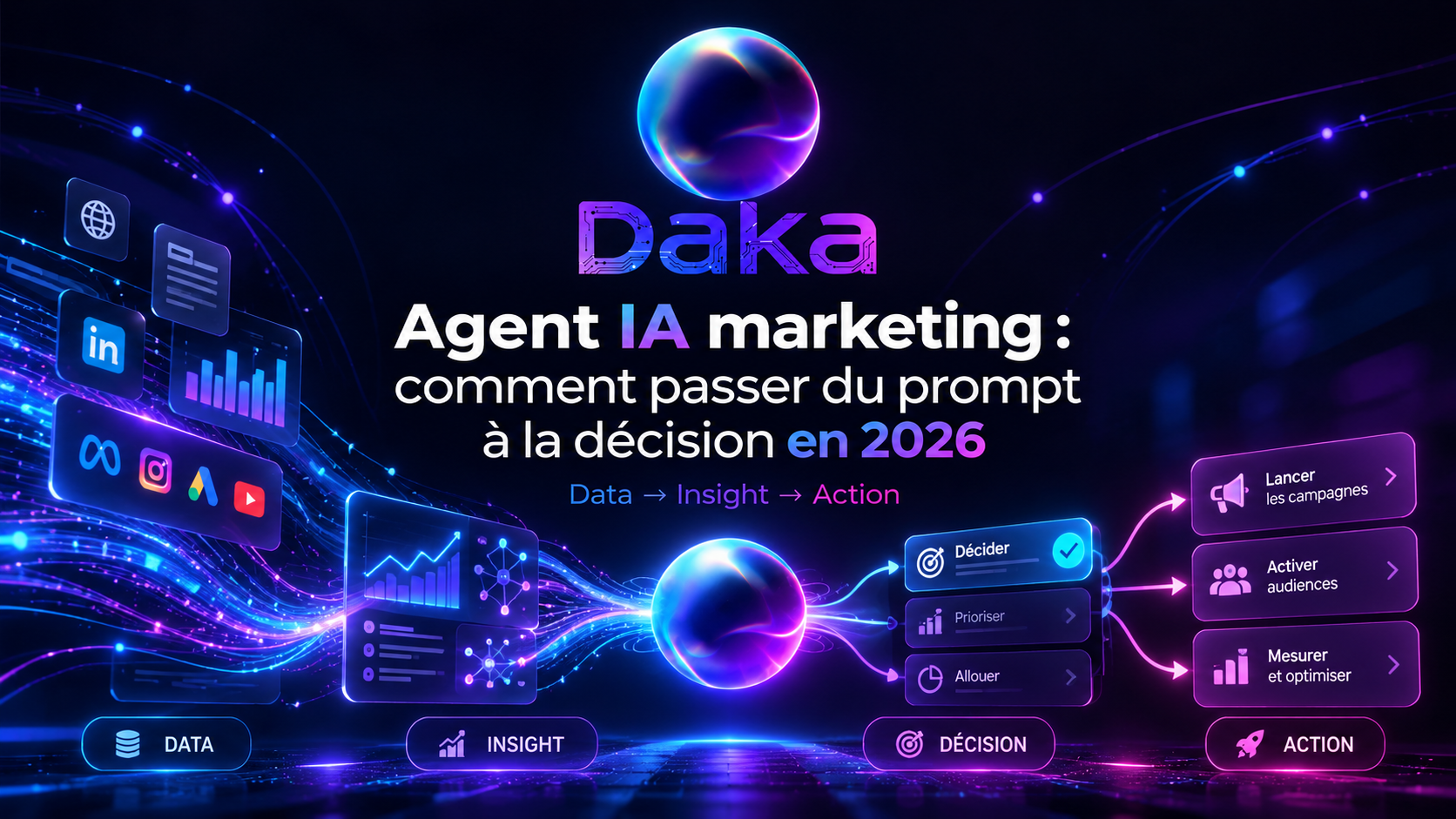
A useful AI marketing workflow can be reduced to this:
Data → Insight → Hypothesis → Decision → Action → Result → Learning
That is also the logic behind the DAKA approach.
Research does not live separately from execution.
The information gathered at the beginning should influence the offer.
The offer should influence the message.
The message should influence the campaign.
And campaign results should influence the next decision.
That is what turns a group of tools into a learning system.
Data alone creates very little value.
Action alone can create plenty of risk.
The interesting part sits between the two.
It comes from answering one deceptively simple question:
What does this information change about what we should do next?
Practical takeaway: structure AI-agent outputs into four sections:
Observed facts → Interpretation → Hypotheses to test → Recommended actions
You do not need an agent everywhere.
That would probably create more complexity than value.
A better question is:
Where are we currently wasting the most time finding, transferring, comparing or interpreting information?
That is often where the strongest use cases appear.
Imagine analysing twenty competitors manually.
For each one, you may need to examine:
The work is not intellectually difficult.
It is simply tedious to repeat.
An AI agent can absorb much of the collection and organisation, leaving people to focus on the decisions that actually matter.
Do not ask an agent simply to:
“Analyse my competitors.”
Give it a framework.
Ask for:
Offer → Pricing → Positioning → Proof → Objections → Friction → Differentiation
You will get a much more useful result.
Customers say a great deal.
The trouble is that they say it everywhere.
Product reviews.
Support tickets.
Reddit threads.
Comments.
Search engines.
CRM records.
Live chats.
An agent can bring these signals together and identify:
That information can then feed directly into copywriting, offer development and campaign strategy.
Usually far more effectively than a fictional persona created in a meeting room.
The customer’s language is not merely copywriting material.
It is market data.
Repeated complaints can reveal product weaknesses.
Repeated questions can expose uncertainty.
Repeated phrases can reveal how buyers actually think about the problem.
A campaign generates clicks.
Sales do not follow.
Why?
It could be the advert.
Or the offer.
Or the landing page.
Or weak trust signals.
Or confusing pricing.
Or a mismatch between what the ad promises and what the visitor discovers after clicking.
An AI agent can compare those elements and help narrow the diagnosis.
The key word is diagnosis.
Because:
“Conversion is low”
is not a diagnosis.
It is a symptom.
This may be one of the most underrated uses of AI agents.
Marketing teams rarely have a shortage of ideas.
They struggle with a different question:
Which idea deserves to be tested next?
An agent becomes useful when it helps compare opportunities according to:
Forrester’s research suggests this shift is already happening.
Around half of the US agencies surveyed use agentic AI for marketing execution, while 70% use AI for research and competitive intelligence.
But Forrester also gives us a useful warning.
Jay Pattisall describes the risk as:
“Mistaking efficiency for effectiveness.”
Or, more simply:
Doing the wrong thing twice as quickly is still doing the wrong thing.
The KPI for an AI marketing agent should not simply be:
hours saved.
You may also want to track:
Those measures are much closer to business value.
We talk a great deal about models.
Perhaps we should talk more about context.
Two businesses can use exactly the same AI model and produce completely different results.
Why?
One gives the model a sentence and asks for an idea.
The other gives it:
The brain is the same.
The raw material is not.
That is where market intelligence and agentic AI begin to converge.
AI without context can imagine a campaign.
AI with strong context can identify that:
Now the question changes.
It is no longer:
What can we create?
It becomes:
What are the data telling us, and what test logically follows from that evidence?
That principle sits at the heart of DAKA.
Understand the market → Identify demand → Analyse competitors → Diagnose the funnel → Make a decision → Execute → Learn
McKinsey’s 2026 data suggests that AI-agent scaling is progressing faster inside larger organisations.
40% of respondents working for companies generating more than $1 billion in revenue said they were scaling AI agents.
Among smaller organisations, the figure was 22%.
That difference may tell us something important.
Companies with structured data, established processes and connected systems have more useful material to give an AI agent.
The model alone is not the infrastructure.
Gartner, meanwhile, predicts that 60% of brands will use agentic AI to facilitate individualised customer interactions by 2028.
Emily Weiss, Senior Principal Researcher at Gartner, describes the shift rather boldly:
“This marks the end of channel-based marketing as we know it.”
Perhaps.
But before we reach fully agent-orchestrated marketing, many companies have a much more ordinary problem.
Their data are scattered.
Their tools do not communicate properly.
Their learning disappears between campaigns.
That is where the real work starts.
Once AI moves beyond suggesting copy, the consequences change.
A mediocre paragraph?
Rewrite it.
A campaign sent to the wrong audience?
Different problem.
A budget moved automatically to the wrong channel?
More serious.
Bad information inserted into a commercial decision?
Now the stakes are higher.
That is why AI autonomy should not be treated as a simple yes-or-no question.
An agent might:
That middle ground matters.
Microsoft reports that 50% of surveyed AI users believe quality control of AI output has become a more important skill.
EY also found that 36% of senior AI decision-makers surveyed had already experienced an AI incident or failure with a materially negative impact.
John McLain, AI Leader at EY, summarised the issue clearly:
“The biggest agentic AI risk is that human oversight hasn’t evolved accordingly.”
The more an action is:
the stronger the human supervision should be.
By contrast, a task that is:
can usually support a higher degree of autonomy.
Fully autonomous AI may sound exciting.
Carefully controlled autonomy is often smarter.
| Signal | 2026 Data | What It Suggests |
|---|---|---|
| Longer task delegation | 70.2% | AI usage is moving from isolated answers towards delegated work |
| Marketing transformation | 96% | AI ambition is enormous, but integration remains uneven |
| Fragmented usage | 42% | Many companies still have AI tools rather than AI workflows |
| Agent adoption in agencies | ≈50% | Agentic marketing is moving beyond experimentation |
| Human quality control | 50% | More AI does not remove the need for human judgement |
| Operational AI incidents | 36% | Autonomy and governance need to develop together |
These studies use different samples and methodologies, so the percentages should not be compared as if they came from the same population.
Still, the direction is remarkably consistent.
More delegation. More integration. More need for control.
That may be the clearest picture of agentic AI in 2026.
An AI marketing agent is an artificial intelligence system designed to pursue a marketing objective across several steps.
Depending on its permissions, it may research information, analyse data, use external tools, recommend actions and sometimes execute them.
A chatbot primarily responds to an interaction.
An AI agent can pursue an objective across several stages and use external data, tools and workflows.
The line is becoming less rigid, however, because conversational AI products increasingly include agentic capabilities.
Traditional automation usually follows a predefined rule:
If A happens → Do B
An AI agent can have more flexibility to determine which steps are necessary depending on the context it encounters.
Useful applications include:
Technically, yes.
That does not mean it always should.
The appropriate level of autonomy depends on:
Useful safeguards include:
Yes.
But prompting is becoming one part of a broader skill set.
The more valuable ability is increasingly knowing how to:
define the objective, provide context, choose the right data, design the workflow, set limits and evaluate the result.
We have spent several years learning how to talk to AI models.
The next phase may be about learning how to work with them.
That difference matters.
A prompt can give you an excellent answer.
A workflow can take a question, search for evidence, use tools, identify uncertainty, prepare a decision and turn the result into new learning.
That is a deeper change than it first appears.
When everyone can generate an advert, presentation, image or landing page in minutes, production gradually stops being scarce.
Context is still scarce.
Reliable data are still scarce.
Judgement is still scarce.
And the ability to learn faster than competitors remains extremely valuable.
So perhaps the most useful question around AI marketing agents is not:
How much can we automate?
It is:
How much uncertainty can we remove before making a decision?
That is where agentic AI becomes genuinely useful.
Not when it replaces thinking.
When it helps a business connect:
Market signals → Evidence → Insight → Decision → Action → Learning
The prompt is still here.
It simply is not the centre of the story anymore.
The centre is the loop:
A company that shortens that loop without sacrificing the quality of its decisions does more than save time.
It learns faster.
DAKA is built around a straightforward operating principle:
Data → Insight → Decision → Action
Instead of treating market research, competitor analysis, funnel diagnosis and execution as separate tasks, DAKA connects them into a decision workflow.
The goal is not simply to generate more marketing content.
It is to understand:
What is the market signalling?
What deserves attention?
What should we test next?
Discover DAKA by MKTN Strategix